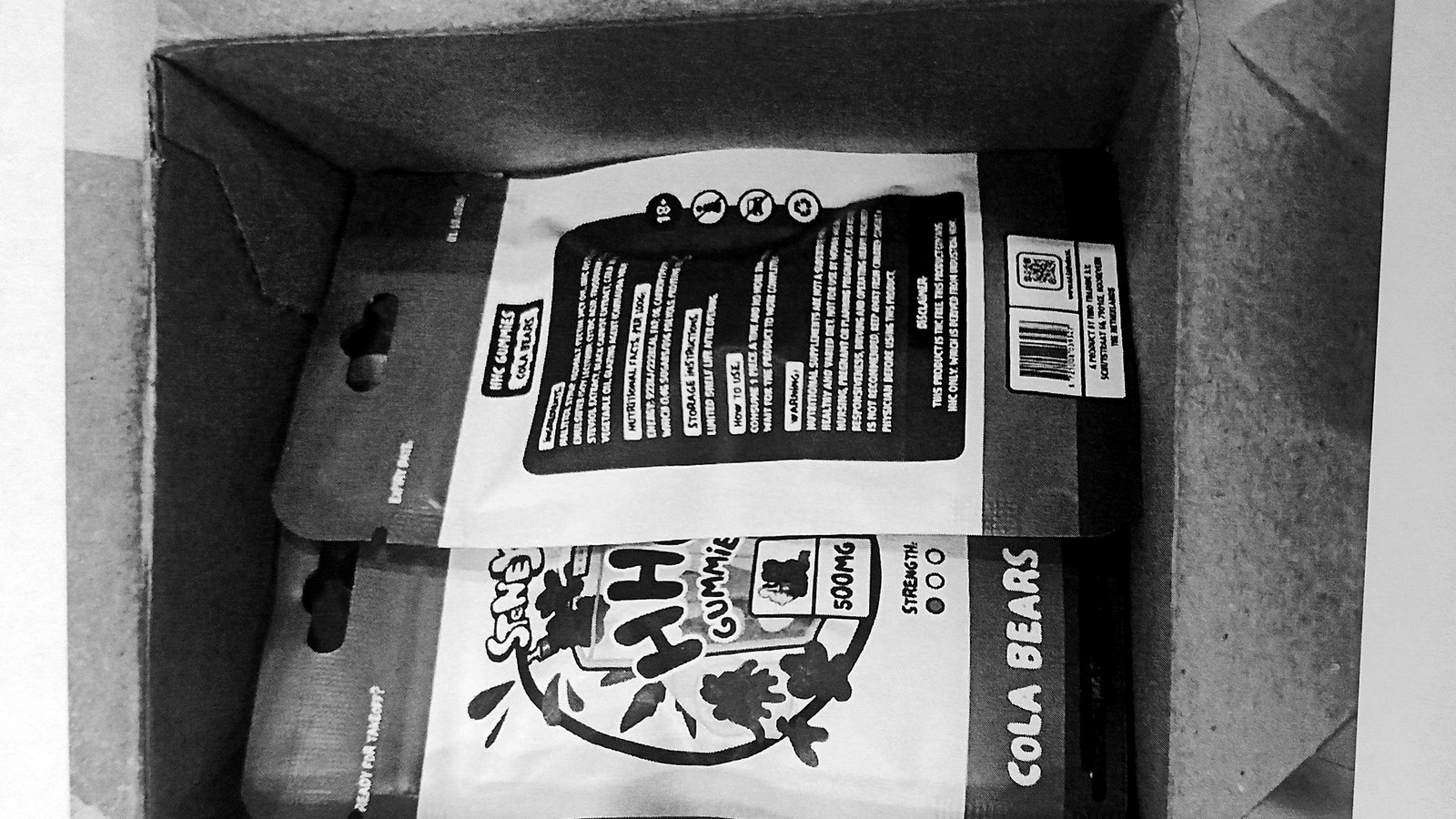
Five minutes into the interview, the woman across the table wanted to make sure I understood what I was doing.
"You realize you're confessing right now?"
"Yes," I said. The man next to her typed it down, the German interpreter relayed both lines back to me in case I'd missed them, and we moved on to the next question, which was about my internet habits. I had no idea that we had eighty-five more minutes to go.
This was the twelfth of May, at an office of the Swedish customs authority, Tullverket, in the Gärdet district of Stockholm, the part of town where Sweden does its quiet, well-funded administrative work behind the windows of converted nineteenth-century buildings. The thing I was confessing to was ordering sleep gummies from a Dutch webshop called Stonedoos, a name worth filing away because the joke keeps paying out as the story progresses, and which translates from Dutch roughly as stoner, in the couch-bound sense of the word. The gummies contained HHC, a semi-synthetic cannabinoid that has killed nobody on record and that was, at the time I clicked "buy" in December 2025, perfectly legal in the country I was buying it from. The Dutch government banned HHC on the 28th of January 2026, exactly thirty-three days after Swedish customs intercepted my package and roughly three months before I sat down at the Tullverket table. For most of 2025, in other words, a substance that would put me in front of a Swedish judge was sitting on Dutch shop shelves, regulated only by the Amsterdam coffee-shop sensibility that has historically tolerated rather more than the Swedish one.
Three grams of active substance, roughly the cannabis equivalent of twenty grams of flower. Or, by the arithmetic the court eventually preferred, a hundred and twenty-seven grams of candy, each gummy bear counted as a single dose of narcotics. That is the entire factual basis of the case that brought me, on the eleventh of June, into Sal 4 of Nacka Tingsrätt, the district court that serves the southern half of Stockholm county. I am forty-eight years old. I grew up in Germany, lived in Malta, lived in Spain, paid taxes in all of them, and never gave any of those countries a reason to write me up. The five-year mark I will now carry on my Swedish criminal record is the first entry of its kind I have ever earned, anywhere, and it is for sleep candy.
The hearing itself took fifteen minutes, which is less time than I'd spent that morning convincing myself it would be fine. My defender was court-appointed and sharp, the sort of man who has done this enough times to have a settled face for it, and he had told me on the drive over that the system would be friendlier than I was bracing for, and he was right. The judge greeted me warmly enough. The court clerk, who typed everything in a steady professional patter, was polite in the specific way of court clerks the world over, which is to say correct and entirely uninterested. The prosecutor turned out to be the warmest of the lot: a man in his forties with an iPad and a small, recurring smile that I came to recognize as the smile of a person doing his job while privately wondering whether his job, today, was a good use of anyone's afternoon. He proposed sixty dagsböter, day-fines calibrated to income, a Nordic invention designed to ensure that a fine hurts a millionaire and a freelance journalist roughly equally, and the judge said the written verdict would arrive by the 22nd of June, because the court still needed to calculate what one of my days is currently worth in kronor. The number, when it came, was small. The court set each of my days at fifty kronor, the statutory floor, which is the state's own assessment that I am, by Swedish standards in the second quarter of 2026, a freelancer in roughly the way a goldfish is a swimmer.
Throughout the proceedings, my defender returned to the fact of my confession with the frequency of a man worried it might evaporate if unattended. He told the judge. He told the prosecutor. He came close, at one point, to telling the German interpreter, who was already aware. Swedish criminal procedure, I came to understand, is built around the assumption that the accused will spend the entire hearing trying to dance out from under the charge, and the lawyers seem mildly disoriented when somebody simply confirms the facts and waits to see what happens next. The system rewards the dance. It is less sure what to do with the person standing still.
While I was sitting in Sal 4 listening to my charges read aloud, a former police officer named Katja Nyberg was somewhere in Stockholm preparing for her own day in court, scheduled for September. Nyberg, until recently a member of Sweden's parliament for the Sweden Democrats — the right-populist party that sits comfortably in the governing coalition that wrote the laws I had just broken — has been charged with aggravated unlicensed driving, drunk driving, minor drug use, and possession of narcotics. The Sweden Democrats are the party of law and order, of clean streets and firm hands, of cracking down on the immigrant gangs that the party's spokespeople will tell you, in measured tones and at considerable length, are responsible for Sweden's drug problem. Nyberg, before her parliamentary career, was a police officer. She then became the Sweden Democrats' parliamentary spokesperson on police matters.
On the 28th of December 2025, Nyberg was stopped by police on suspicion of drunk driving. The roadside test came back positive for impairment. A search of her car turned up 1.18 grams of cocaine in a small bag. A blood test confirmed cocaine in her system. A subsequent hair analysis, performed by the Swedish National Forensic Centre and reported by the public broadcaster SVT, turned up traces of ecstasy and amphetamine as well. She is keen to establish that she was not over the alcohol limit, which does nothing whatever for the cocaine. Her lawyer, Martin Orler, has publicly told the Swedish press that her chances of acquittal are, and I quote, "realistic."
She denies the cocaine. She says she has no idea how it got into the bag in her car. Swedish criminal procedure gives wide weight to a defendant's word when other interpretations remain possible, and other interpretations always remain possible if you are willing to keep offering them. I, who admitted everything at the first opportunity and signed a svarsblankett (the response form Swedish prosecutors send you to confirm you accept their reading of events), am the one with sixty dagsböter incoming. Nyberg, the police-spokesperson-turned-MP caught with three substances in her hair and one in her bag, may walk. The pattern here is not subtle. It is, in fact, the entire pattern.
A note on the Swedish state and its relationship with intoxicants, because the Swedish state is itself the dealer. The retail sale of any beverage above 3.5 percent alcohol is the monopoly of Systembolaget, a government-owned chain whose handsome green-and-yellow signage is so ubiquitous in Stockholm that visitors occasionally assume it must be selling something more uplifting than wine. In 2023, Systembolaget moved 38.2 billion kronor of product, which is roughly the entire GDP of the Maldives, and the same year Sweden recorded 2,168 alcohol-related deaths, a figure published by Folkhälsomyndigheten, the public health agency that also publishes the leaflets explaining, in gentle Scandinavian prose, why Swedes might want to consider drinking less. The agency does not, to my knowledge, comment on whether its parent ministry, Health, has ever sat down with the ministry that owns Systembolaget, Finance, and noticed the contradiction.
HHC, by contrast, has killed nobody. Not three grams of it, not three kilos of it, not anywhere on the planet that anyone has been able to document. The substance was sold openly in Swedish convenience stores and candy shops until the eleventh of July 2023, at which point the Ministry of Health placed it on the narcotics schedule by decree. The kiosks were not raided. The previous customers, of which there were thousands and which included, presumably, some not insignificant fraction of the personnel currently employed to prosecute them, were not registered. The line moved, and anyone still ordering from a Dutch retailer eighteen months later, me for example, discovered the line had moved when their package was opened by a customs officer in a warehouse in Jönköping.

The prosecutor, to be fair to him, made this point in court. He noted, correctly, that my having checked the legal status of HHC in 2023 was no defence under Swedish law, because the importer of a substance is responsible for knowing its current classification at the moment of import. I accept this. It is the correct legal standard. This piece is a complaint about the spectacular gap between the institutional energy directed at me, the customs lab, the interpreter, the court clerk, the prosecutor's afternoon, the publicly funded defender, the judge in his soft suit, the months of file-keeping, and the institutional energy directed at the cocaine that, in January 2024, an Aftonbladet reporter detected on the toilet surfaces of four of the seven parliamentary parties' offices inside the Swedish parliament. The reporter used commercial cocaine wipes that turn blue on contact. The wipes were sent to Anders Helander, a chemist at the Karolinska Institute, who confirmed the findings under laboratory conditions. The toilets in question were used by members and staff of the Social Democrats, the Left Party, the Liberals, and, with the sort of casting that would get a satirist accused of laying it on thick, the Sweden Democrats.
The parties' explanation, delivered with a rare cross-aisle unity, was that the toilets were technically accessible to visitors. Tourists, perhaps. Schoolchildren. The same Swedes whom Folkhälsomyndigheten is gently advising to drink less.
Here is what fifteen minutes in Sal 4 looked like. A judge in a soft suit, slightly distracted by something on his papers. A prosecutor with an iPad and a refillable water bottle, the kind every employed Swede under fifty seems to carry. The word Stonedoos, pronounced aloud by said prosecutor in formal Swedish, sounding exactly as dignified as you'd expect. My defender at my side, calm in the way of a man who does this twice a week and has long since stopped finding it dramatic. A court clerk in the corner typing on a Bluetooth keyboard. A German interpreter I'd never met before, who turned out to be excellent, and whose entire afternoon's labour consisted of translating the prosecutor reading the indictment aloud, my defender saying han erkänner brottet, he confesses to the crime, in a tone of mild boredom, and the judge asking, near the end, whether I had anything I wished to add. I did not. On my defender's advice, I kept the long version for the piece you are reading right now. The prosecutor smiled one final time, the clerk stopped typing, everyone stood, and I was processed and dismissed in the time it takes to drink a coffee, with the verdict to follow by mail in eleven days.
The five-year belastningsregister entry (the word for the Swedish criminal record, belastning meaning roughly "burden," which is the kind of administrative honesty Sweden specializes in) I already have. It will sit there until the summer of 2031. Anyone running a background check during that window will see it. Probably nobody will. The mark exists nonetheless, and on the day it expires I will be fifty-three years old, and the Sweden Democrats will probably still be in some coalition, and somewhere in a different Stockholm courtroom another former police officer will be telling another judge that the bag in the car was, on reflection, not really hers.
I am, for the record, an idiot for not re-checking the Swedish drug code in 2025. The prosecutor's point is correct, and I take it on the chin. I should have been more careful. I should have read the news in a language I do not read. I should have foreseen, in the autumn of 2025, that the Dutch retailer I had been buying from for two years across two other EU countries would not include a small note at checkout reading please be aware that the Swedish Ministry of Health has reclassified this product as a narcotic, and that the country you are shipping to enforces this with the seriousness usually reserved for plutonium.
But the prosecutor is not a man holding forth at a dinner party on the subject of civic responsibility. He is an officer of the Swedish state, and the state he serves operates the largest alcohol retailer in Northern Europe, oversees more than two thousand alcohol-related deaths every year, cannot keep cocaine out of its own parliamentary toilets, and has just spent a förhör (an investigative interview), a slutdelgivning (the bureaucratic notice that closes an investigation), a courtroom, a judge, a clerk, an interpreter, a publicly funded defender, and an entire afternoon of its own prosecutor's time on the question of whether a freelance writer who ordered a sleep aid from a webshop named after sofa-dwellers should carry a five-year administrative scar for his trouble.
The answer, on the eleventh of June, was yes. I have no quarrel with the law as written. I have a quarrel with the law as enforced, selectively and theatrically, with the energy of an institution that needs to be seen doing something while being literally wiped down for traces of the substance it claims to abhor.
Sweden does not have a drug problem. Sweden has a drug-policy problem, which is a more expensive disease and considerably harder to legislate against.
The Systembolaget on Karlavägen opens at ten.